General Theory of the Coherence Field (GTCF)

A coherent alternative to dark matter and dark energy

The General Theory of the Coherence Field (GTCF) is a gravitational framework that unifies galactic and cosmological scales. It reproduces MOND-like dynamics in galaxies, preserves General Relativity at linear order, and generates dark energy without a cosmological constant.

Explore the Framework

Why rethink gravity?

Modern cosmology is built on the \(\Lambda\)CDM model: cold dark matter plus a cosmological constant. While \(\Lambda\)CDM successfully explains the cosmic microwave background and expansion history, it systematically fails on galactic scales.

On these scales, rotation curves and scaling relations strongly correlate with visible (baryonic) matter. GTCF is a concrete proposal that:

What is the General Theory of the Coherence Field?

GTCF introduces a shift-symmetric scalar coherence field \( \Phi \) with a non-local kinetic structure. It is a mathematically consistent field theory with clear, testable predictions.

Key features:

Galactic-scale tests

Rotation curves, RAR, BTFR, HSB/LSB

GTCF has been tested against the SPARC database of 175 galaxies. Results show a global acceleration scale of \( a_0 = 3.86 \times 10^{-11} \, \text{m/s}^2 \) with no per-galaxy tuning.

Radial Acceleration Relation (RAR)
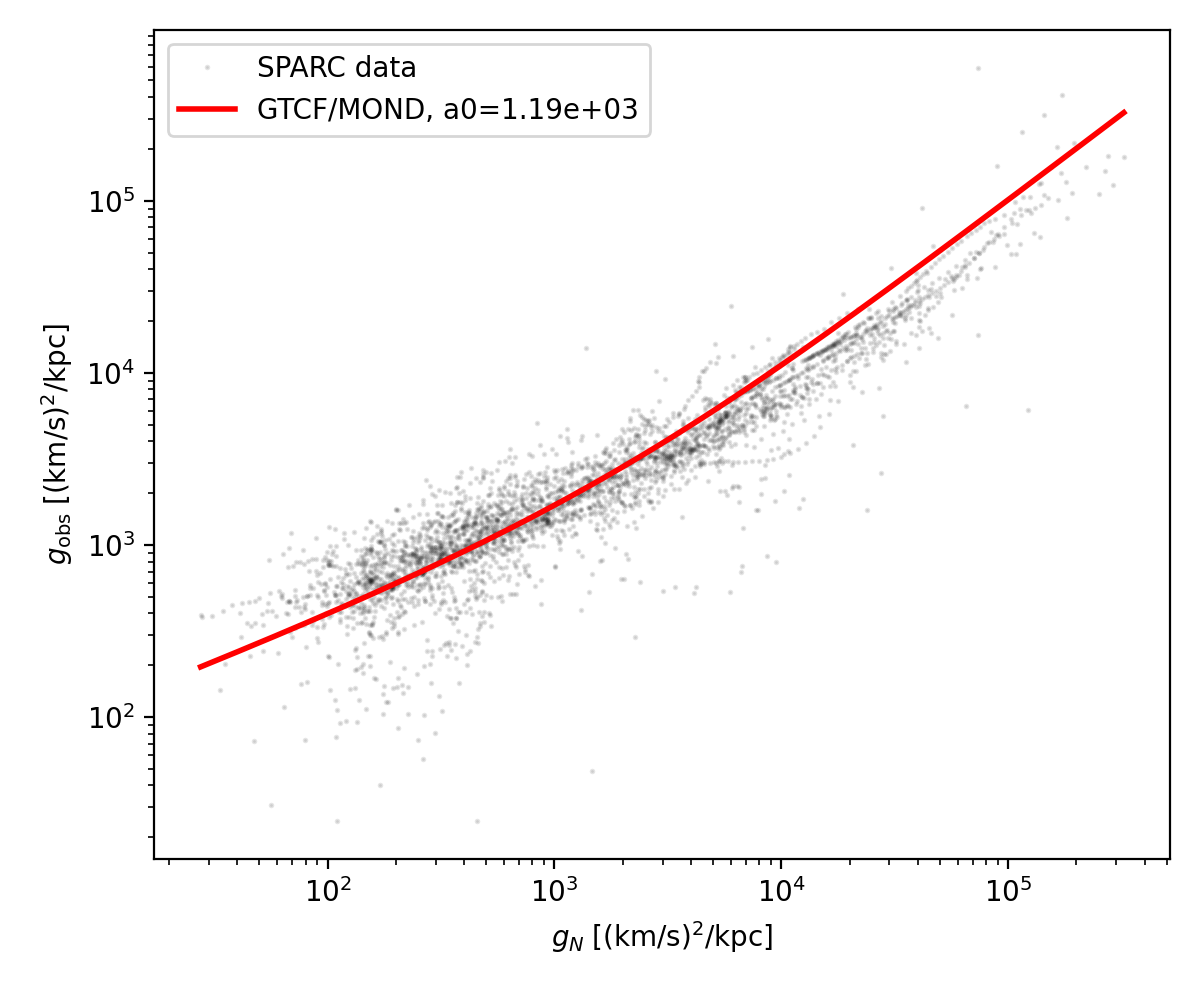
RAR: Gray dots, Red curve

Observed radial acceleration vs. Newtonian acceleration. GTCF prediction: \( g_{obs} = g_N \nu(g_N / a_0) \). Gray points: Data | Red curve: GTCF.

The slope of 3.59 is within the observed range and emerges naturally from the coherence field dynamics.

Baryonic Tully–Fisher Relation (BTFR)
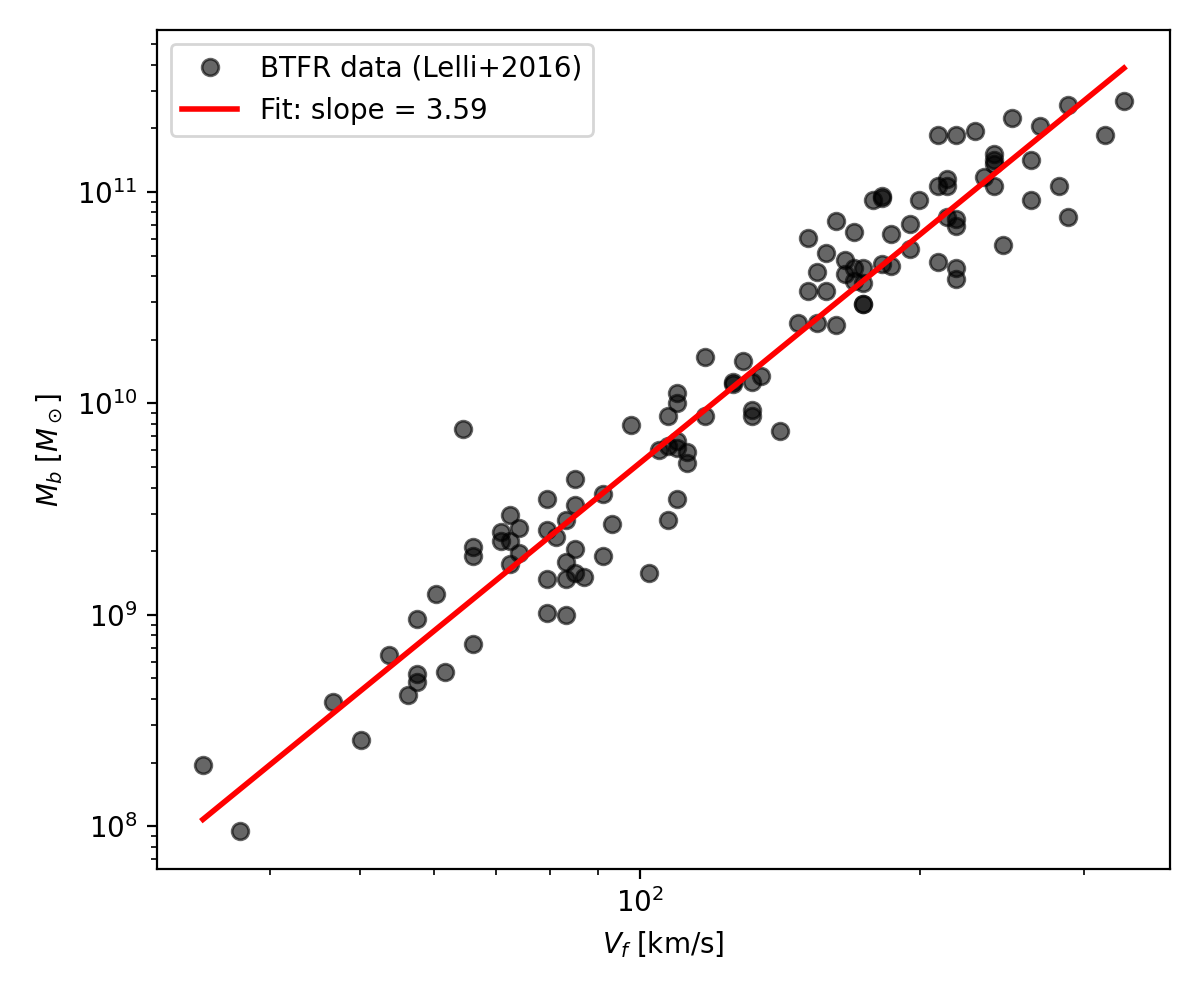
BTFR: Gray dots, Red line

GTCF predicts \( M_b \propto V_f^4 \). Gray points: Data | Red line: Fit (Slope 3.59).
Cosmic expansion without \(\Lambda\)

On an FRW background, the coherence field follows a kinetic branch \( X(a) = C a^{-6} \). The Friedmann equation becomes:

\[ H^2(z) = H_0^2 [ \Omega_m(1+z)^3 + \Omega_r(1+z)^4 + \Omega_{stiff}(1+z)^{12} + \Omega_{DE} ] \]

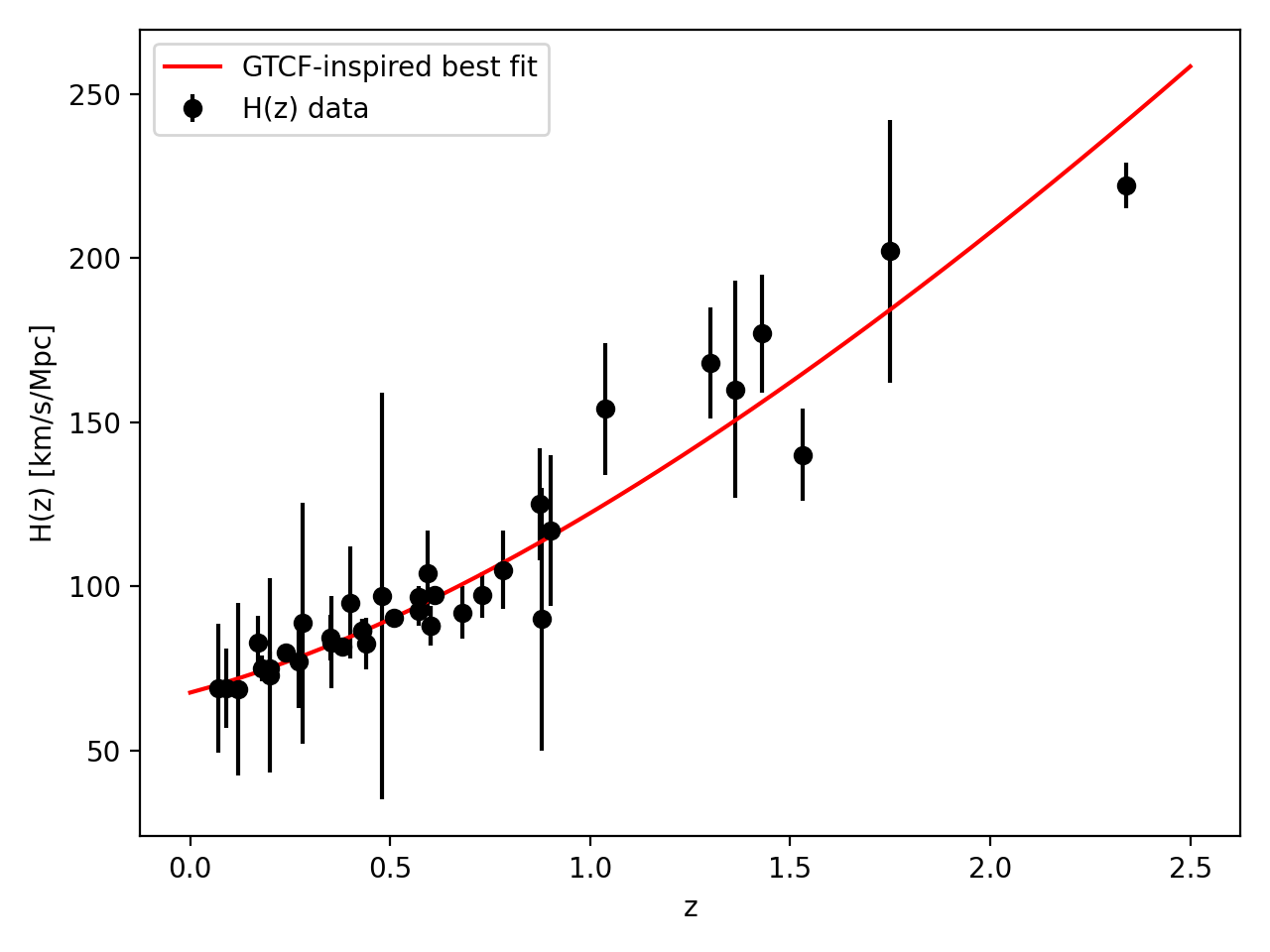
Hubble expansion history H(z)

H(z): Black points, Red curve

Measured Hubble expansion rate. \( H_0 = 70 \, \text{km/s/Mpc} \), \( \Omega_{DE} \approx 0.7 \). Black: Data | Red: GTCF.

Structure formation and linear growth

A key property of GTCF is that the field does not contribute linear perturbations (\( \delta T_{\mu\nu}(\phi) = 0 \)). The growth equation remains identical to GR:

\[ D'' + \left( 3a + \frac{H'}{H} \right) D' - \frac{3}{2} \Omega_m(a) a^2 D = 0 \]

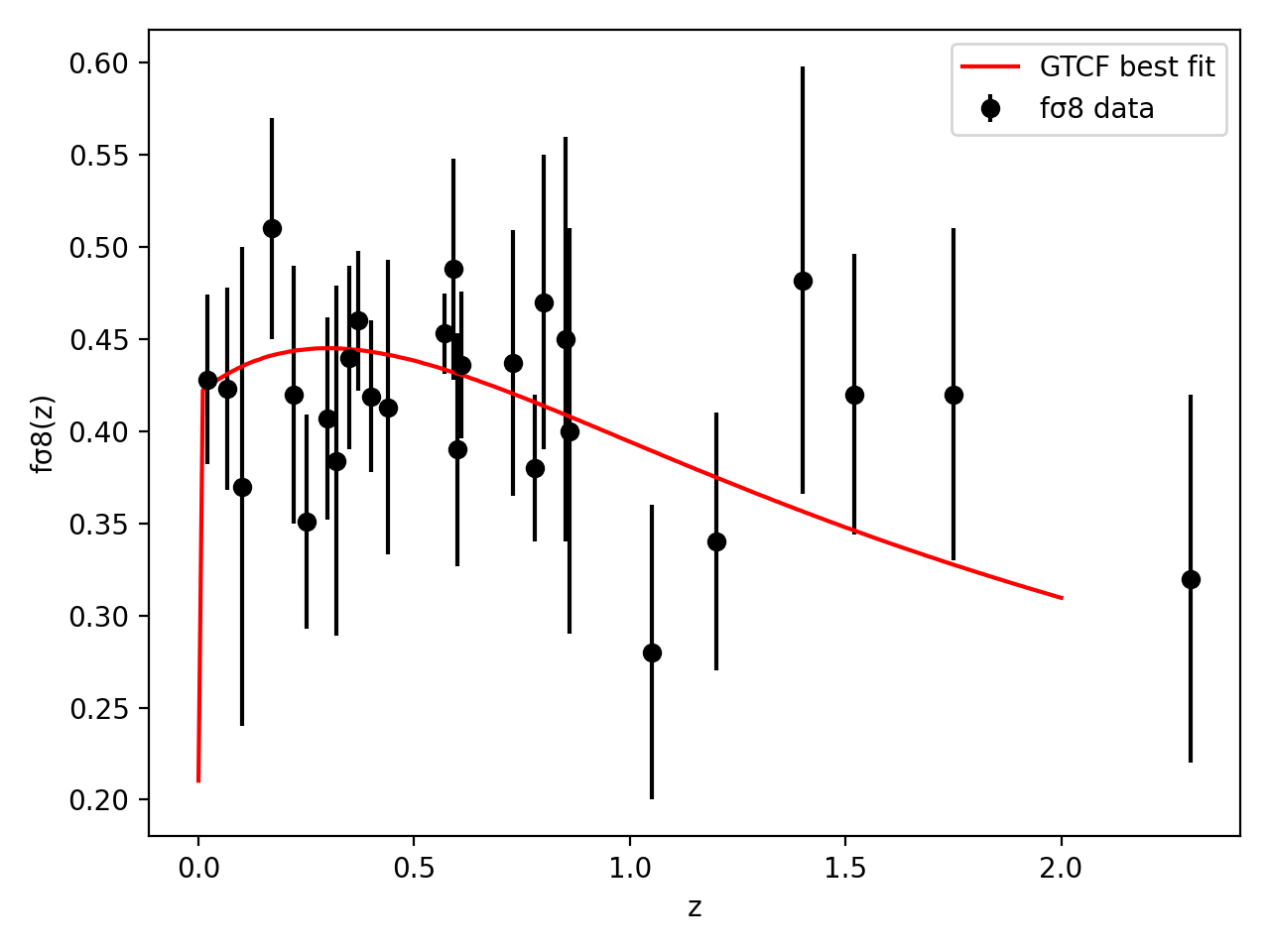
Growth rate \( f\sigma_8(z) \)

fsigma8: Black dots, Red curve

Growth rate of structure. Black points: RSD Data | Red curve: GTCF (\( S_8 \simeq 0.95 \)).

What GTCF passes

  • RAR / BTFR / HSB-LSB
  • \( H(z) \) expansion history
  • \( f\sigma_8(z) \) growth of structure
  • GR at linear order
  • MOND-like galactic dynamics
  • No dark matter halos / No \(\Lambda\)

Next steps and open tests

To fully assess GTCF, advanced tests are required:

Why GTCF could change our view of gravity

GTCF offers a coherent picture in which galactic dynamics and cosmology are described within a single framework. Dark energy is not a mysterious constant but an emergent effect, and GR remains valid where it is strongly tested.

GTCF is one of the few frameworks that simultaneously matches galactic phenomenology and cosmological observations without invoking dark matter halos or a cosmological constant.

Open framework, open protocol

The GTCF framework is publicly available as a scientific good for scrutiny and further development.

Last updated: February 12, 2026

omni-coherence.org

Omni-Coherence Research Group | 2026